 Bao CRM
Follow-up email after no response: 8 templates for clients and prospects
Send a follow-up email three to five working days after your first message, in the same thread. Keep it to two or three lines: remind the client of the context, ask one easy question and sign off. If there is still no reply, send a second follow-up a week later, then a last email that closes the loop politely. Below are 8 templates to copy, for clients and prospects.
This guide is for freelancers and small businesses following up with clients and prospects. For a quote specifically, see our quote follow-up email templates.
When to send a follow-up email after no response
| Follow-up | When | Goal |
|---|---|---|
| First follow-up | 3 to 5 working days after your email | Check it was seen |
| Second follow-up | About a week later | Make replying easy, or ask if priorities changed |
| Last email | A week or two after that | Close the loop and leave the door open |
If the client gave you a date (“I’ll know by Friday”), ignore this timeline and follow up the next working day. Avoid Monday mornings and Friday afternoons, when inboxes are at their fullest.
How to write a follow-up email after no response
- Reply in the same thread, so your first email is right underneath.
- Give the context in one sentence: the topic, the date, the project.
- Ask one easy question, ideally one that can be answered with yes, no or a date.
- Add something new when you can: a summary, an option, a real deadline.
- Keep it short. Two to four lines is enough. A follow-up gets read on a phone.
Skip “Just following up” and “I wanted to circle back”: start directly with the topic.
Subject lines for a follow-up email
- Quick question about [project]
- Next step for [project]?
- [Project]: should I keep this open?
- Your proposal for [project]
- Closing the loop on [topic]
Name the topic plainly. A subject line that tells the reader what the email is about gets opened more than a clever one.
8 follow-up email templates after no response
Copy them and replace everything in brackets. Each one asks for a single thing.
1. A gentle nudge, three to five days later
Subject: Quick follow-up on [topic]
Hi [first name],
Just checking that my email from [day] about [topic] reached you.
Do you have any questions I can answer?
Best,
[signature]
2. A short follow-up email
Subject: [Topic]: one question
Hi [first name], is [project] still planned for [period]? A one-line answer is perfect.
Thanks,
[signature]
3. After a proposal or a quote
Subject: Your proposal for [project]
Hi [first name],
I sent you the proposal for [project] on [date]. Is there anything you would like me to clarify or adjust before you decide?
Best,
[signature]
4. After a call or a meeting
Subject: Next step for [project]?
Hi [first name],
Thanks again for our call on [day]. As promised, [what you sent or did].
What would be the best next step on your side?
Best,
[signature]
5. To a prospect who went quiet after a first exchange
Subject: Still looking for help with [need]?
Hi [first name],
We spoke about [need] a couple of weeks ago. Is it still on your list?
If the timing is wrong, just say so and I will get back to you in a few months.
Best,
[signature]
6. When someone else makes the decision
Subject: Can I help with [project]?
Hi [first name],
If the decision depends on someone else, I can send you a one-page summary to share, or talk to them directly.
Which would help most?
Best,
[signature]
7. Second follow-up email after no response
Subject: [Topic]: should I keep this open?
Hi [first name],
I have not heard back about [topic], so I imagine priorities have shifted. Should I keep this open for now, or come back to you later in the year?
Either answer is fine.
Best,
[signature]
8. The last email: close the loop
Subject: Closing the loop on [topic]
Hi [first name],
As I have not heard back, I will close this on my side for now.
If [topic] comes back up, just reply to this email and we will pick it up from there.
All the best,
[signature]
Mistakes to avoid
- Guilt-tripping. “I’m surprised I haven’t heard back” makes replying uncomfortable. Make it easy instead.
- Repeating the same email. Each follow-up should be shorter or bring something new.
- Asking several questions. One question gets more replies than three.
- Inventing urgency. Use real deadlines only.
- Following up forever. Three emails is plenty; then close the loop.
Never forget to send a follow-up
The hardest part of following up is remembering to do it. Note the date of the next follow-up as soon as you send an email, in your calendar, a spreadsheet or a CRM. In Notion, our free Notion CRM template has a Follow-up date property for exactly this.
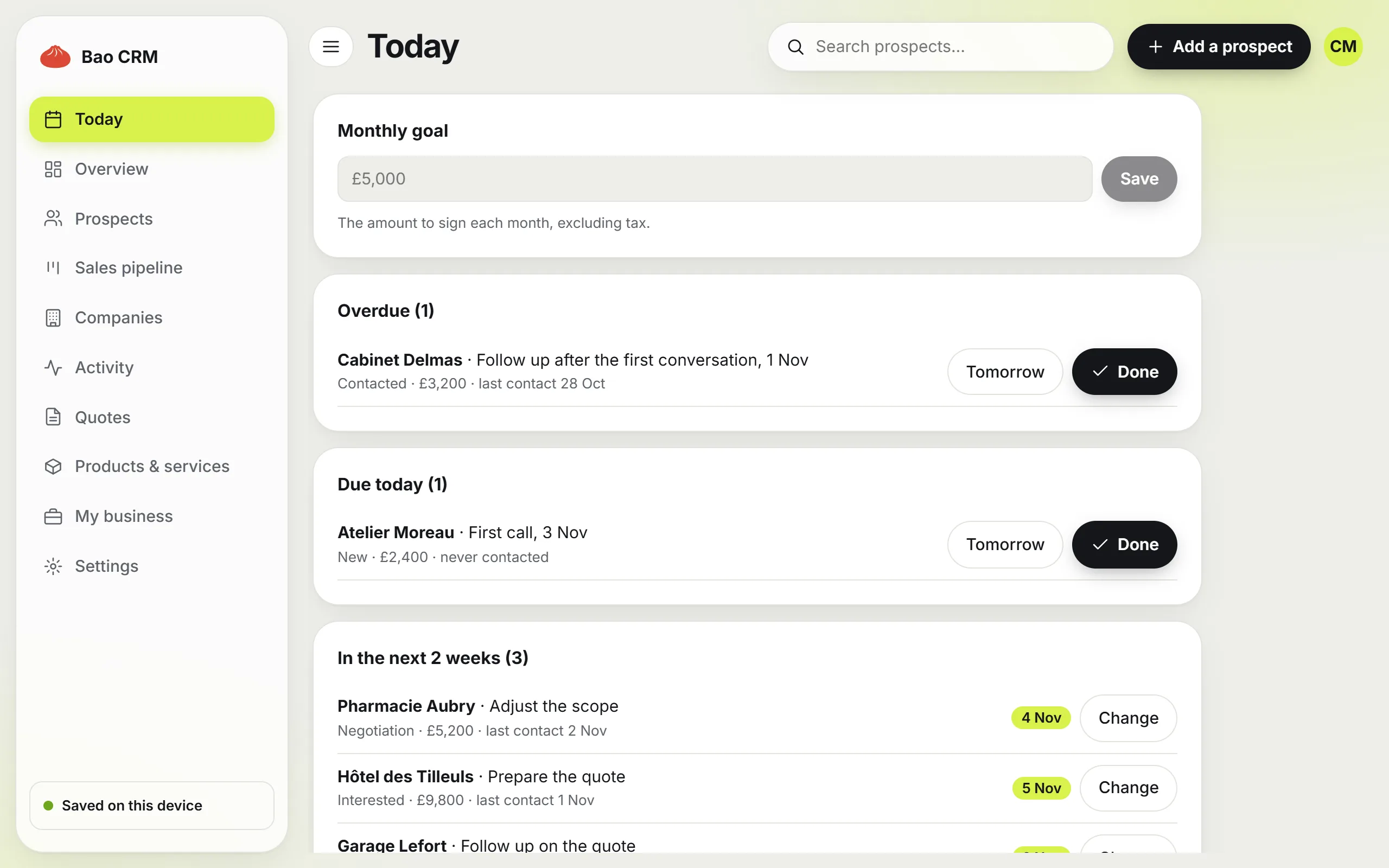
Bao CRM goes one step further: its Today page lists the follow-ups that are overdue and due today, and opens a ready-made message in your usual email app. You still reread and send each one yourself.
Frequently asked questions
How long should I wait before sending a follow-up email after no response?
Three to five working days for most business emails. Wait a full week for a busy client or a large decision, and follow up the day after any date the client gave you.
How many follow-up emails should I send?
Two or three, spaced further apart each time: after three to five days, then about a week later, then a last email. After that, stop and move on.
What should the subject line of a follow-up email be?
Keep the original thread when you can, so the context is right there. Otherwise, name the topic plainly: “Quick question about [project]” or “Next step for [project]?” works better than “Following up”.
How do I write a short follow-up email?
Two or three lines: the context in one sentence, one easy question, and your name. A short email gets read on a phone and answered between two meetings.
Is it rude to send a follow-up email?
No. People miss emails all the time, and a polite follow-up helps them. What feels rude is pressure: guilt-tripping, fake urgency or a dozen reminders.
What if the client still does not respond?
Send a last email saying you will close the topic for now and that they can reply any time. Then note it in your CRM and move on; many of these clients come back later.